Out of all the years of Magic: The Gathering, 2025 was definitely one of them. A lot happened. Some of it was great. Some of it was the kind of “great” that makes you stare at the wall for a minute and wonder why you chose cardboard as a hobby.
This post is my take on the best MTG things of 2025, specifically the stuff Wizards of the Coast did (products, decisions, course-corrections). I’m not ranking “cool community moments,” because then we’d be here all day and i’d have to admit Magic players are often better at running Magic than the people who run Magic.
Also, yes, you’re going to notice a couple of obvious contenders floating around this year. And yes, one of them is “complicated.” That’s Magic, baby.
Best MTG things of 2025: what actually deserves a slow clap
Let’s start with an honorable mention, then hit the list.
Honorable mention: Pioneer finally becomes “Pioneer” on MTG Arena
For years, Arena players had “Explorer,” which was basically Pioneer with a promise and a shopping list. In 2025, Wizards finally did the thing: Explorer got rebranded to Pioneer, with the ban list aligned to tabletop Pioneer. That sounds like a naming tweak, but it matters because it’s Wizards admitting, “okay, fine, you were right, this is Pioneer.”
If you like Pioneer, this is the best kind of digital support: low friction, always available, and full of people who will absolutely cast three spells in your end step because they’re on a phone at the dentist.
Is it perfect? No. There are still missing cards, and Pioneer still needs real love in paper. But having a real Pioneer button on Arena is better than watching the format slowly fade into “remember when we cared about this?”
5) Wizards postponed Secret Lair x Monster Hunter (and that was good)
This one feels weird to celebrate, but hear me out.
Wizards revealed a Secret Lair x Monster Hunter drop, the community reacted like they’d been handed a sandwich that was technically food but spiritually disrespectful, and Wizards actually pulled back. Not “we hear you” corporate fluff. A real “we’re postponing this and reworking it.”
That matters because it’s proof there is, in fact, a line. Wizards is willing to say: “This isn’t ready. This doesn’t meet expectations. We’re not shipping it like this.”
And look, i’m not pretending this is a new era of humility. But even one clean backpedal is better than the usual approach of “ship it now, apologize later, print a slightly different version next quarter.”
Also, the sponsor bit writes itself: if you’re trying to buy hot products without paying scalper tax, apparently the move is “go somewhere that enforces limits and sells at MSRP.” What a concept.
4) Secret Lair Dandân is what Secret Lair should have been all along
Secret Lair is usually “Here are five cards, please experience feelings.” Sometimes it’s fun. Sometimes it’s just expensive confetti.
But the Dandân drop is different. It’s a full, ready-to-play experience: an 80-card shared deck micro-format you can open, sleeve, shuffle, and play. That’s the key word: play. Not just collect.
If you’ve never played Dandân (also called Forgetful Fish), the pitch is simple: two players share the same deck and graveyard, and the “win condition” is basically a weird fish that becomes lethal when your opponent forgets how math works. It’s tense, swingy, and surprisingly skill-testing for something that looks like a joke until it isn’t.
The even better part: the conversation around credit and creator involvement. Dandân exists because Nick Floyd built it and pushed it for years. Wizards initially stumbled on that. Then they brought him into the fold, and the drop got pushed back to give that collaboration room to breathe.
That’s exactly the kind of “please slow down and do it right” delay i can live with.
And if 2025 taught us anything, it’s that more Magic products should be “a complete night of gameplay in a box,” not “another stack of rares you feel vaguely guilty about owning.”
3) Competitive play kept getting real support (Spotlight Series, RCQs, the pipeline)
Competitive Magic has been on a long journey from “peak Pro Tour era” to “so, what are we doing now?” In 2025, one of the clearest wins was Wizards continuing to invest in organized play in ways that normal humans can actually access.
The Magic Spotlight Series is the headline. These events are open-entry and they pay out something players actually care about: the top finishers qualify for the Pro Tour. No grinding pro points across 47 weekends. You pick your spots, you show up, you play.
In 2025 there were eight Spotlight events across the US, Europe, and Japan. And in 2026, the lineup expands to 12 events, including more regions getting real shots at big-stage play. That’s not just “more tournaments.” That’s Wizards saying competitive Magic is worth calendar space.
And then there’s the local-to-global path: RCQ to Regional Championship to Pro Tour. That pipeline still matters because it starts where most of us actually play: at local stores, with real people, and a judge who has seen too many arguments about layers.
If you love competitive Magic, 2025 wasn’t perfect, but it was one of the best years in a long time for “you can realistically try to qualify without selling your soul.”
2) Tarkir: Dragonstorm Commander decks were absurdly good
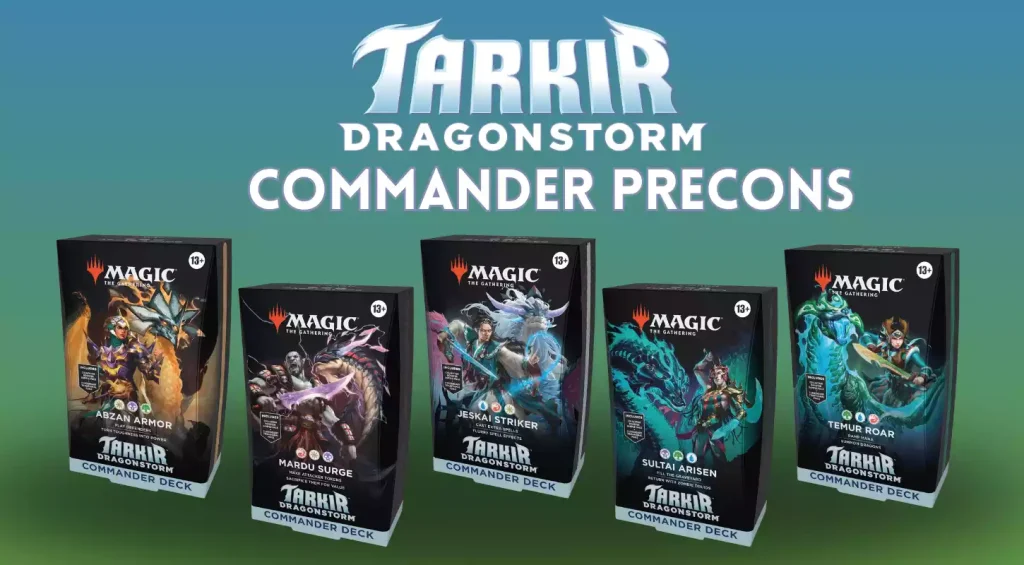
The Tarkir: Dragonstorm Commander precons were the rare Commander product that hits three goals at once:
- playable out of the box
- thematic in a way you can feel
- upgradeable without turning into a completely different deck
You’ve got the five clans, five identities, and five decks that actually feel distinct. They’re strong, they’re coherent, and they don’t read like someone built them by dumping “popular EDH cards” into a blender.
It’s also the kind of product that helps newer players. You can buy one deck, sit down, and your deck does the thing it says it does. No scavenger hunt required.
And yes, I’m aware it’s mildly hilarious that one of the best things in 2025 was “they made precons that feel like they were designed with care.” But here we are.
1) Universes Beyond actually landed: Final Fantasy and Avatar
Okay. Let’s talk about the elephant, the other elephant, and the third elephant that’s actually a Moogle.
If you’re allergic to Universes Beyond, you probably had a rough year emotionally. But if we’re judging execution, both Final Fantasy and Avatar: The Last Airbender did the job they were supposed to do.
They translated the source material into Magic mechanics that mostly feel like Magic. Not just name swaps. Not just flavor pasted onto random cards. Actual design work.
Final Fantasy’s biggest win was cultural gravity. It pulled in people who genuinely were not Magic players, then gave them enough on-ramps to become Magic players. That’s the dream scenario for a crossover: not just “sell product,” but “grow the table.”
Avatar, meanwhile, is the kind of set that makes you go, “oh, you can still design a great draft environment on purpose.” Strong themes, clean mechanical identity, and a Standard impact that wasn’t just one pushed card stomping everything else.
So yeah, in my opinion, the top spot is basically a tie: one set that brought in fresh blood, and one set that reminded us Magic can still be elegant when it wants to be.
What this means if you actually play the game (and not just argue about it)
Here’s the practical takeaway from the best MTG things of 2025:
- Arena getting real Pioneer support is good if you want reps fast.
- Secret Lair can be more than collectibles if Wizards chooses to make it about play.
- Competitive Magic is healthier when the path is clear and the events are plentiful.
- Commander precons can still be memorable when design leads and spreadsheets follow.
- Universes Beyond is not going away, so the best outcome is “do it well,” not “pretend it isn’t happening.”
And if 2025 sets have you brewing nonstop but you’re not trying to pay collector-booster prices just to test a deck idea, proxies are the obvious pressure valve. Start with this guide on How to Make MTG Proxies and, seriously, read Are Proxies Legal in MTG? Understanding Proxy Cards so you don’t accidentally show up to the wrong event with the wrong expectations.
2025 was messy. But it wasn’t hopeless. And i’ll take “messy but improving” over “quietly on fire” any year.